
According to GFI Software, strengthening corporate email protection is the most effective defense
PRAGUE, June 24, 2024 – GFI Software, a provider of security solutions for enterprise networks, stated that, according to its survey conducted among Czech and Slovak partners, credential theft and targeted spoofed emails (BEC/Spear Phishing) have the greatest potential to cause financial damage. Phishing emails play one of the main roles in this, as they can deceive corporate users with a wide range of fraudulent information, including unpaid invoices, fabricated debts, or non-existent deliveries.
Companies are increasingly encountering sophisticated phishing campaigns behind credential theft, leading to attacks on their systems and subsequently to ransomware attacks. Among other things, BEC campaigns use deepfake voice technologies to initiate payment orders to cyber attackers' accounts. It is therefore important to pay attention in particular to the growing number of phishing emails, increasingly using AI-generated content and sophisticated social engineering methods.
Key survey findings:
- From the perspective of potential financial damage, credential theft (50%), BEC emails (28%), and the disclosure of sensitive information (22%) are the most dangerous threats for companies.
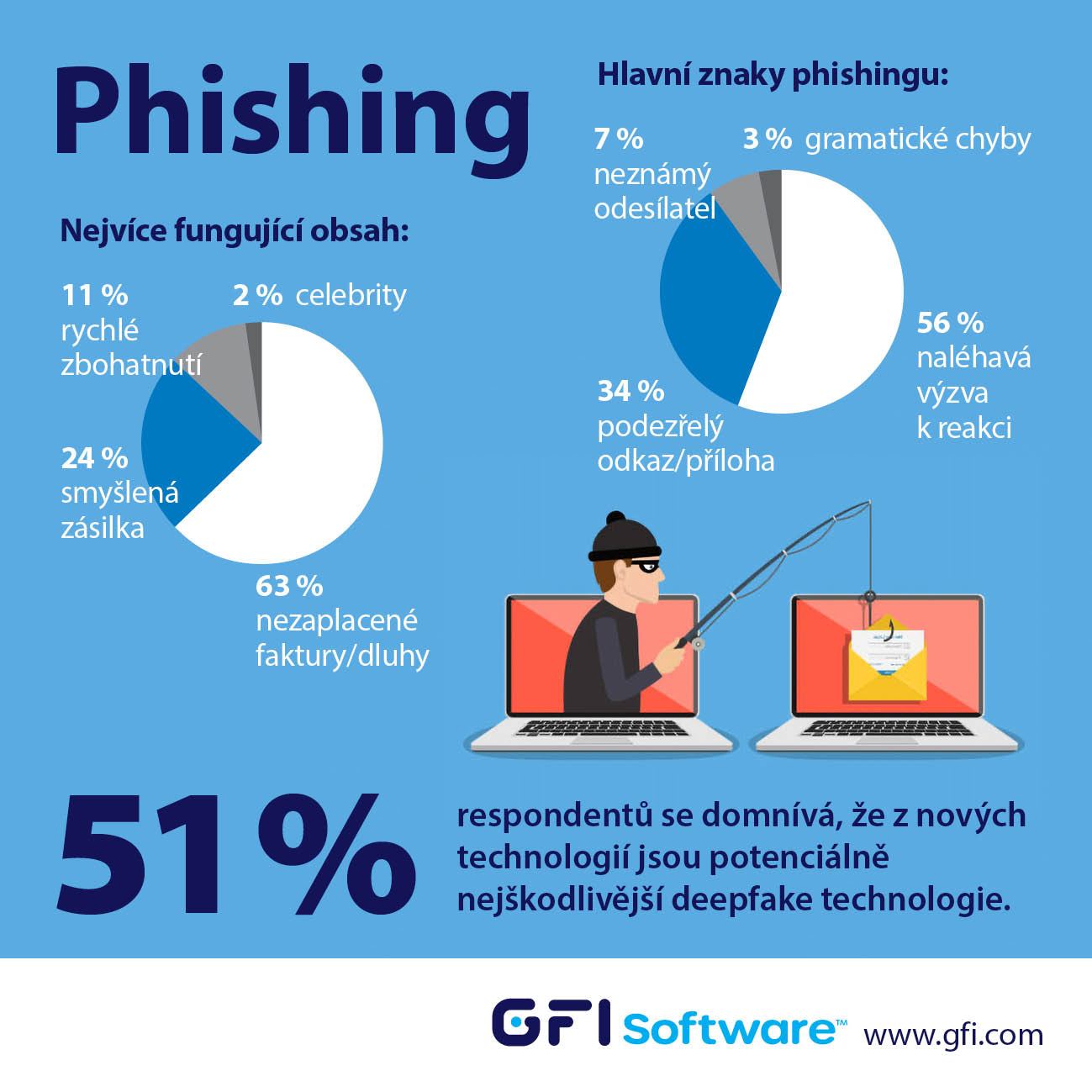
- According to 56% of respondents, the most common sign of a phishing email is an urgent call to respond; for 34% of respondents, it is a suspicious link or attachment; and for 7%, an unknown sender.
- Regarding email content, 63% of experts believe that a message about an unpaid invoice or outstanding amount is the most reliable way to confuse users, followed by information about a fictitious delivery (24%) and an offer of quick riches (10%).
- The largest share of respondents (51%) believe that, among new technologies, deepfake videos or voice messages are potentially the most harmful.
“Phishing emails have long been the most widely used vector of cyberattacks and, unfortunately, also a very financially successful one from hackers' perspective,” said Jozef Kačala, Vice President of Global Sales Engineering at GFI Software. “We must reckon with the possibility that users in companies will probably never be completely immune to social engineering methods, which is why technical measures such as email filtering on the mail server are needed to reduce the number of phishing emails to a minimum. However, even this minimum still means that we need to take into account that some phishing emails will get through protection, whether due to missing rules or human error. And if that happens, we must be prepared for it.”
GFI MailEssentials is a corporate email protection solution that includes anti-phishing filters alongside antivirus and anti-spam filters, blocking emails with suspicious links and content and thus reducing the likelihood of risky user behavior. MailEssentials is one of the products that recently integrated the CoPilot add-on, built on artificial intelligence (AI), for automatically creating custom filtering rules that reflect the company's environment and possible data that could be leaked. CoPilot will focus primarily on data loss prevention (DLP), taking into account the possibility that a phishing attack (whether via email, SMS, or phone call) may be successful and an employee may unintentionally send unwanted information to an attacker.
Article author: ZEBR.ai editorial team